Telepathy ( courtecy;- From Wikipedia, the free encyclopedia )Jump to navigationJump to search For other uses, see Telepathy (disambiguation). This article is about the paranormal phenomenon. For the magical act, see mentalism.
Telepathy
| Part of a series on the |
| Paranormal |
|---|

Telepathy (from the Greek τῆλε, tele meaning "distant" and πάθος, pathos or -patheia meaning "feeling, perception, passion, affliction, experience")[3][4] is the purported transmission of information from one person to another without using any known human sensory channels or physical interaction. The term was coined in 1882 by the classical scholar Frederic W. H. Myers,[5]a founder of the Society for Psychical Research,[6] and has remained more popular than the earlier expression thought-transference.[6][7]
Telepathy experiments have historically been criticized for lack of proper controls and repeatability. There is no convincing evidence that telepathy exists, and the topic is generally considered by the scientific community to be pseudoscience.[8][9][10][11]
Contents
Origins of the concept[edit]
According to historians such as Roger Luckhurst and Janet Oppenheim the origin of the concept of telepathy in Western civilization can be tracked to the late 19th century and the formation of the Society for Psychical Research.[12][13] As the physical sciences made significant advances, scientific concepts were applied to mental phenomena (e.g., animal magnetism), with the hope that this would help to understand paranormal phenomena. The modern concept of telepathy emerged in this context.[13]
Psychical researcher Eric Dingwall criticized SPR founding members Frederic W. H. Myers and William F. Barrett for trying to "prove" telepathy rather than objectively analyze whether or not it existed.[14]
Thought reading[edit]
In the late 19th century, the magician and mentalist, Washington Irving Bishop would perform "thought reading" demonstrations. Bishop claimed no supernatural powers and ascribed his powers to muscular sensitivity (reading thoughts from unconscious bodily cues).[15] Bishop was investigated by a group of scientists including the editor of the British Medical Journal and the psychologist Francis Galton. Bishop performed several feats successfully such as correctly identifying a selected spot on a table and locating a hidden object. During the experiment Bishop required physical contact with a subject who knew the correct answer. He would hold the hand or wrist of the helper. The scientists concluded that Bishop was not a genuine telepath but using a highly trained skill to detect ideomotor movements.[16]
Another famous thought reader was the magician Stuart Cumberland. He was famous for performing blindfolded feats such as identifying a hidden object in a room that a person had picked out or asking someone to imagine a murder scene and then attempt to read the subject's thoughts and identify the victim and reenact the crime. Cumberland claimed to possess no genuine psychic ability and his thought reading performances could only be demonstrated by holding the hand of his subject to read their muscular movements. He came into dispute with psychical researchers associated with the Society for Psychical Research who were searching for genuine cases of telepathy. Cumberland argued that both telepathy and communication with the dead were impossible and that the mind of man cannot be read through telepathy, but only by muscle reading. [17]
Case studies[edit]

In the late 19th century the Creery Sisters (Mary, Alice, Maud, Kathleen, and Emily) were tested by the Society for Psychical Research and believed to have genuine psychic ability. However, during a later experiment they were caught utilizing signal codes and they confessed to fraud.[18][19] George Albert Smith and Douglas Blackburn were claimed to be genuine psychics by the Society for Psychical Research but Blackburn confessed to fraud:
Between 1916 and 1924, Gilbert Murray conducted 236 experiments into telepathy and reported 36% as successful, however, it was suggested that the results could be explained by hyperaesthesia as he could hear what was being said by the sender.[21][22][23][24][25] Psychologist Leonard T. Troland had carried out experiments in telepathy at Harvard University which were reported in 1917.[26][27][28][29] The subjects produced below chance expectations.[30]
Arthur Conan Doyle and W. T. Stead were duped into believing Julius and Agnes Zancig had genuine psychic powers. Both Doyle and Stead wrote the Zancigs performed telepathy. In 1924, Julius and Agnes Zancig confessed that their mind reading act was a trick and published the secret code and all the details of the trick method they had used under the title of Our Secrets!! in a London newspaper.[31]
In 1924, Robert H. Gault of Northwestern University with Gardner Murphy conducted the first American radio test for telepathy. The results were entirely negative. One of their experiments involved the attempted thought transmission of a chosen number, out of 2010 replies none were correct.[32]
In February 1927, with the co-operation of the British Broadcasting Corporation (BBC), V. J. Woolley who was at the time the Research Officer for the SPR, arranged a telepathy experiment in which radio listeners were asked to take part. The experiment involved 'agents' thinking about five selected objects in an office at Tavistock Square, whilst listeners on the radio were asked to identify the objects from the BBC studio at Savoy Hill. 24, 659 answers were received. The results revealed no evidence for telepathy.[33][34]
A famous experiment in telepathy was recorded by the American author Upton Sinclair in his book Mental Radio which documents Sinclair's test of psychic abilities of Mary Craig Sinclair, his second wife. She attempted to duplicate 290 pictures which were drawn by her husband. Sinclair claimed Mary successfully duplicated 65 of them, with 155 "partial successes" and 70 failures. However, these experiments were not conducted in a controlled scientific laboratory environment.[35] Science writer Martin Gardner suggested that the possibility of sensory leakage during the experiment had not been ruled out:

The Turner-Ownbey long distance telepathy experiment was discovered to contain flaws. May Frances Turner positioned herself in the Duke Parapsychology Laboratory whilst Sara Ownbey claimed to receive transmissions 250 miles away. For the experiment Turner would think of a symbol and write it down whilst Ownbey would write her guesses.[36] The scores were highly successful and both records were supposed to be sent to J. B. Rhine; however, Ownbey sent them to Turner. Critics pointed out this invalidated the results as she could have simply written her own record to agree with the other. When the experiment was repeated and the records were sent to Rhine the scores dropped to average.[36][37][38]
Another example is the experiment carried out by the author Harold Sherman with the explorer Hubert Wilkins who carried out their own experiment in telepathy for five and a half months starting in October 1937. This took place when Sherman was in New York and Wilkins was in the Arctic. The experiment consisted of Sherman and Wilkins at the end of each day to relax and visualise a mental image or "thought impression" of the events or thoughts they had experienced in the day and then to record those images and thoughts on paper in a diary. The results at the end when comparing Sherman's and Wilkins' diaries were claimed to be more than 60 percent.[39]
The full results of the experiments were published in 1942 in a book by Sherman and Wilkins titled Thoughts Through Space. In the book both Sherman and Wilkins had written they believed they had demonstrated that it was possible to send and receive thought impressions from the mind of one person to another.[40] The magician John Booth wrote the experiment was not an example of telepathy as a high percentage of misses had occurred. Booth wrote it was more likely that the "hits" were the result of "coincidence, law of averages, subconscious expectancy, logical inference or a plain lucky guess".[41] A review of their book in the American Journal of Orthopsychiatry cast doubt on their experiment noting "the study was published five years after it was conducted, arouses suspicion on the validity of the conclusions.[42]
In 1948, on the BBC radio Maurice Fogel made the claim that he could demonstrate telepathy. This intrigued the journalist Arthur Helliwell who wanted to discover his methods. He found that Fogel's mind reading acts were all based on trickery, he relied on information about members of his audience before the show started. Helliwell exposed Fogel's methods in a newspaper article. Although Fogel managed to fool some people into believing he could perform genuine telepathy, the majority of his audience knew he was a showman.[43]
In a series of experiments Samuel Soal and his assistant K. M. Goldney examined 160 subjects over 128,000 trials and obtained no evidence for the existence of telepathy.[44] Soal tested Basil Shackleton and Gloria Stewart between 1941 and 1943 in over five hundred sittings and over twenty thousand guesses. Shackleton scored 2890 compared with a chance expectation of 2308 and Gloria scored 9410 compared with a chance level of 7420. It was later discovered the results had been tampered with. Gretl Albert who was present during many of the experiments said she had witnessed Soal altering the records during the sessions.[44] Betty Marwick discovered Soal had not used the method of random selection of numbers as he had claimed. Marwick showed that there had been manipulation of the score sheets "all the experiments reported by Soal had thereby been discredited."[45][46]
In 1979 the physicists John G. Taylor and Eduardo Balanovski wrote the only scientifically feasible explanation for telepathy could be electromagnetism (EM) involving EM fields. In a series of experiments the EM levels were many orders of magnitude lower than calculated and no paranormal effects were observed. Both Taylor and Balanovski wrote their results were a strong argument against the validity of telepathy.[47]
Research in anomalistic psychology has discovered that in some cases telepathy can be explained by a covariation bias. In an experiment (Schienle et al. 1996) 22 believers and 20 skeptics were asked to judge the covariation between transmitted symbols and the corresponding feedback given by a receiver. According to the results the believers overestimated the number of successful transmissions whilst the skeptics made accurate hit judgments.[48] The results from another telepathy experiment involving 48 undergraduate college students (Rudski, 2002) were explained by hindsight and confirmation biases.[49]
In parapsychology[edit]
Within the field of parapsychology, telepathy is considered to be a form of extrasensory perception (ESP) or anomalous cognition in which information is transferred through Psi. It is often categorized similarly to precognition and clairvoyance.[50] Experiments have been used to test for telepathic abilities. Among the most well known are the use of Zener cards and the Ganzfeld experiment.
Types[edit]
Parapsychology describes several forms of telepathy:[7]
- Latent telepathy, formerly known as "deferred telepathy",[51] is described as the transfer of information, through Psi, with an observable time-lag between transmission and reception.[7]
- Retrocognitive,[not in citation given] precognitive, and intuitive[not in citation given] telepathy is described as being the transfer of information, through Psi, about the past, future or present state of an individual's mind to another individual.[7]
- Emotive telepathy, also known as remote influence[52] or emotional transfer, is the process of transferring kinesthetic sensations through altered states.
- Superconscious telepathy involves tapping into the superconscious[53] to access the collective wisdom of the human species for knowledge.
Zener Cards[edit]
.svg)
Zener cards are marked with five distinctive symbols. When using them, one individual is designated the "sender" and another the "receiver". The sender selects a random card and visualize the symbol on it, while the receiver attempts to determine that symbol using Psi. Statistically, the receiver has a 20% chance of randomly guessing the correct symbol, so to demonstrate telepathy, they must repeatedly score a success rate that is significantly higher than 20%.[54] If not conducted properly, this method can be vulnerable to sensory leakage and card counting.[54]
J. B. Rhine's experiments with Zener cards were discredited due to the discovery that sensory leakage or cheating could account for all his results such as the subject being able to read the symbols from the back of the cards and being able to see and hear the experimenter to note subtle clues.[55] Once Rhine took precautions in response to criticisms of his methods, he was unable to find any high-scoring subjects.[56] Due to the methodological problems, parapsychologists no longer utilize card-guessing studies.[57]
Dream telepathy[edit]
Parapsychological studies into dream telepathy were carried out at the Maimonides Medical Center in Brooklyn, New York led by Stanley Krippner and Montague Ullman. They concluded the results from some of their experiments supported dream telepathy.[58] However, the results have not been independently replicated.[59][60][61][62] The psychologist James Alcock has written the dream telepathy experiments at Maimonides have failed to provide evidence for telepathy and "lack of replication is rampant."[63]
The picture target experiments that were conducted by Krippner and Ullman were criticized by C. E. M. Hansel. According to Hansel there were weaknesses in the design of the experiments in the way in which the agent became aware of their target picture. Only the agent should have known the target and no other person until the judging of targets had been completed, however, an experimenter was with the agent when the target envelope was opened. Hansel also wrote there had been poor controls in the experiment as the main experimenter could communicate with the subject.[64]
An attempt to replicate the experiments that used picture targets was carried out by Edward Belvedere and David Foulkes. The finding was that neither the subject nor the judges matched the targets with dreams above chance level.[65] Results from other experiments by Belvedere and Foulkes were also negative.[66]
Ganzfeld experiment[edit]
When using the Ganzfeld experiment to test for telepathy, one individual is designated the receiver and is placed inside a controlled environment where they are deprived of sensory input, and another is designated the sender and is placed in a separate location. The receiver is then required to receive information from the sender. The nature of the information may vary between experiments.[67]
The ganzfeld experiment studies that were examined by Ray Hyman and Charles Honorton had methodological problems that were well documented. Honorton reported only 36% of the studies used duplicate target sets of pictures to avoid handling cues.[68] Hyman discovered flaws in all of the 42 ganzfeld experiments and to access each experiment, he devised a set of 12 categories of flaws. Six of these concerned statistical defects, the other six covered procedural flaws such as inadequate documentation, randomization and security as well as possibilities of sensory leakage.[69] Over half of the studies failed to safeguard against sensory leakage and all of the studies contained at least one of the 12 flaws. Because of the flaws, Honorton agreed with Hyman the 42 ganzfeld studies could not support the claim for the existence of psi.[69]
Possibilities of sensory leakage in the ganzfeld experiments included the receivers hearing what was going on in the sender's room next door as the rooms were not soundproof and the sender's fingerprints to be visible on the target object for the receiver to see.[70][71]
Hyman also reviewed the autoganzfeld experiments and discovered a pattern in the data that implied a visual cue may have taken place:
Hyman wrote the autoganzfeld experiments were flawed because they did not preclude the possibility of sensory leakage.[69] In 2010, Lance Storm, Patrizio Tressoldi, and Lorenzo Di Risio analyzed 29 ganzfeld studies from 1997 to 2008. Of the 1,498 trials, 483 produced hits, corresponding to a hit rate of 32.2%. This hit rate is statistically significant with p < .001. Participants selected for personality traits and personal characteristics thought to be psi-conducive were found to perform significantly better than unselected participants in the ganzfeld condition.[72]Hyman (2010) published a rebuttal to Storm et al. According to Hyman "reliance on meta-analysis as the sole basis for justifying the claim that an anomaly exists and that the evidence for it is consistent and replicable is fallacious. It distorts what scientists mean by confirmatory evidence." Hyman wrote the ganzfeld studies have not been independently replicated and have failed to produce evidence for telepathy.[73] Storm et al. published a response to Hyman claiming the ganzfeld experimental design has proved to be consistent and reliable but parapsychology is a struggling discipline that has not received much attention so further research on the subject is necessary.[74] Rouder et al. 2013 wrote that critical evaluation of Storm et al.'s meta-analysis reveals no evidence for telepathy, no plausible mechanism and omitted replication failures.[75]
A 2016 paper examined questionable research practices in the ganzfeld experiments.[76]
Twin telepathy[edit]
Twin telepathy is a belief that has been described as a myth in psychological literature. Psychologists Stephen Hupp and Jeremy Jewell have noted that all experiments on the subject have failed to provide any scientific evidence for telepathy between twins.[77] According to Hupp and Jewell there are various behavioral and genetic factors that contribute to the twin telepathy myth "identical twins typically spend a lot of time together and are usually exposed to very similar environments. Thus, it's not at all surprising that they act in similar ways and are adept at anticipating and forecasting each other's reactions to events."[77]
A 1993 study by Susan Blackmore investigated the claims of twin telepathy. In an experiment with six sets of twins one subject would act as the sender and the other the receiver. The sender was given selected objects, photographs or numbers and would attempt to psychically send the information to the receiver. The results from the experiment were negative, no evidence of telepathy was observed.[78]
The skeptical investigator Benjamin Radford has noted that "Despite decades of research trying to prove telepathy, there is no credible scientific evidence that psychic powers exist, either in the general population or among twins specifically. The idea that two people who shared their mother's womb — or even who share the same DNA — have a mysterious mental connection is an intriguing one not borne out in science."[79]
Scientific reception[edit]
A variety of tests have been performed to demonstrate telepathy, but there is no scientific evidence that the power exists.[9][80][81][82] A panel commissioned by the United States National Research Council to study paranormal claims concluded that "despite a 130-year record of scientific research on such matters, our committee could find no scientific justification for the existence of phenomena such as extrasensory perception, mental telepathy or 'mind over matter' exercises... Evaluation of a large body of the best available evidence simply does not support the contention that these phenomena exist."[83] The scientific community considers parapsychology a pseudoscience.[84][85][86][87] There is no known mechanism for telepathy.[88] Philosopher and physicist Mario Bunge has written that telepathy would contradict laws of science and the claim that "signals can be transmitted across space without fading with distance is inconsistent with physics".[89]
Physicist John Taylor has written the experiments that have been claimed by parapsychologists to support evidence for the existence of telepathy are based on the use of shaky statistical analysis and poor design, and attempts to duplicate such experiments by the scientific community have failed. Taylor also wrote the arguments used by parapsychologists for the feasibility of such phenomena are based on distortions of theoretical physics as well as "complete ignorance" of relevant areas of physics.[90]
Psychologist Stuart Sutherland wrote that cases of telepathy can be explained by people underestimating the probability of coincidences. According to Sutherland, "most stories about this phenomenon concern people who are close to one another - husband and wife or brother and sister. Since such people have much in common, it is highly probable that they will sometimes think the same thought at the same time."[91]Graham Reed, a specialist in anomalistic psychology, noted that experiments into telepathy often involve the subject relaxing and reporting the 'messages' to consist of colored geometric shapes. Reed wrote that these are a common type of hypnagogic image and not evidence for telepathic communication.[92]
Outside of parapsychology, telepathy is generally explained as the result of fraud, self-delusion and/or self-deception and not as a paranormal power.[8][93] Psychological research has also revealed other explanations such as confirmation bias, expectancy bias, sensory leakage, subjective validation and wishful thinking.[94] Virtually all of the instances of more popular psychic phenomena, such as mediumship, can be attributed to non-paranormal techniques such as cold reading.[95][96] Magicians such as Ian Rowland and Derren Brown have demonstrated techniques and results similar to those of popular psychics, without paranormal means. They have identified, described, and developed psychological techniques of cold reading and hot reading.
Psychiatry[edit]
The notion of telepathy is not dissimilar to two clinical concepts: delusions of thought insertion/removal. This similarity might explain how an individual might come to the conclusion that they were experiencing telepathy. Thought insertion/removal is a symptom of psychosis, particularly of schizophrenia, schizoaffective disorder or substance-induced psychosis.[97] Psychiatric patients who experience this symptom falsely believe that some of their thoughts are not their own and that others (e.g., other people, aliens, demons or fallen angels, or conspiring intelligence agencies) are putting thoughts into their minds (thought insertion). Some patients feel as if thoughts are being taken out of their minds or deleted (thought removal). Along with other symptoms of psychosis, delusions of thought insertion may be reduced by antipsychotic medication. Psychiatrists and clinical psychologists believe and empirical findings support the idea that people with schizotypy and schizotypal personality disorder are particularly likely to believe in telepathy.[98][99][100]
Use in fiction[edit]
Telepathy is a common theme in modern fiction and science fiction, with many extraterrestrials (such as the Protoss in the StarCraft franchise), superheroes, and supervillains having telepathic ability.

Mental Telepathy is Real
Scientists show mind-to-mind communication over the Internet
Posted Mar 06, 2015
Mental telepathy, the process of transferring thoughts from one mind to another, has traditionally occupied the realms of either science fiction or the paranormal, both of which are outside of mainstream science.
Research in 2014 has changed all that, with a scientifically validated demonstration of mind-to-mind communication.
Neuroscientist Carlos Grau of the University of Barcelona and colleagues set up a clever experiment in which signals picked up by an Electroencephalagraph EEG from subjects in India were transmitted over the Internet as email messages to other subjects in France whose scalps had been fitted with Trans Cranial Magnetic (TMS) stimulators. TMS devices, which have been used to treat anxiety and depression, electrically stimulate neural activity in the brain through intact scalps using strong magnetic fields. In this experiment, TMS stimulators were placed over the occipital (visual) cortex at the back of the brain, creating a perceived flash of light, called a phosphene, through neural activations in the visual cortex.
The subjects in India were trained to generate an EEG signal representing either a one or a zero using a biofeedback monitor. A one was generated when subjects imagined moving a hand, while a zero was produced when subjects imagined moving a foot. These ones and zeros were then emailed from India to France, and routed to one of two TMS devices mounted on subjects’ scalps. Ones were routed to a TMS electrode that caused a phosphene to be perceived , while Zeros were routed to a different TMS device whose activity produced no phosphenes.
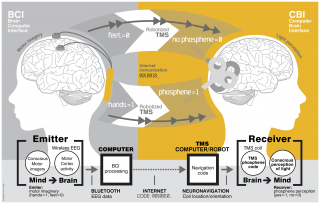
This figure illustrates how the mind to mind communication path worked.
Think of this a kind of neurological Morse code. The researchers encoded a series ones and zeros into words such as “hola” and “ciao,” showing that simple linguistic communication was possible.
The bottom line is that the experiment more or less worked. Error rates of transmission of ones and zeros varied between 1 and 11%, well below what would be expected by random noise.
Why should we care?
Well, one way of viewing this demonstration is that it is as historic as Alexander Graham Bell saying, “Watson, come here, I want to see you:” the first ever voice communication over telephone.
In Grau et al’s experiments, we may be seeing the birth of a revolutionary means of communication that will transform our world in the way the telegraph, telephone, or television did. Someday, instead of texting, speaking or looking into a camera to communicate, we may simply “think” our message, saving all the bother of typing or speaking, or even getting out of the shower.
Finally, if mind to mind communication proves practical, it’s possible that we will learn to communicate subtle ideas and nuances that text, speech and facial expressions cannot, forever changing the way humans relate to each other by amplifying and enriching the depth of communication.
Words sometimes fail us. Thoughts may not!
Mark Zuckerberg says the future of communication is telepathy. Here’s how that would actually work.

Internet satellites, virtual reality, even real working AI: It all pales in comparison to the future that Facebook chief executive Mark Zuckerberg has in mind.
In a Q&A session with site users on Tuesday, the 31-year-old said he envisions a world where people — presumably Facebook users — don’t need these types of communication intermediaries. Instead, they’ll communicate brain-to-brain, using telepathy.
“One day, I believe we’ll be able to send full rich thoughts to each other directly using technology,” Zuckerberg wrote in response to a question about what’s next for Facebook. “You’ll just be able to think of something and your friends will immediately be able to experience it too.”
But hold up: Is that even possible? And is that something anyone actually wants?
TL;DR: Theoretically, yes; and, er — maybe not.
How to read a mind
To understand how Zuckerberg’s vision would theoretically work, you have to understand how the brain works, too.
In a nutshell, your nervous system is composed of cells called neurons, which communicate with each other using chemical signals called neurotransmitters. When a neuron receives one of these signals, it generates a tiny electrical spike. And because millions of these signals are required for everything your brain does — clicking your mouse, reading this text, remembering breakfast, you name it — your brain is basically sending off pinpricks of electrical energy all the time.
The cool thing about this, of course, is that scientists can measure and map this electrical activity using existing technologies like EEG and fMRI machines. And once they have enough maps, they can begin to read them — a point that neuroscientists and researchers are just now approaching.

Videos that were shown to participants in a UC Berkeley experiment (left) and videos that were reconstructed from their brain activity as they watched (right). (UC Berkeley via YouTube)
At the University of California at Berkeley, a team of cognitive scientists have managed to reconstruct clips of movies their subjects were watching, based solely on measurements of their brainwaves. “You could not see the close-up details,” wrote the theoretical physicist Michio Kaku after watching one of the “movies,” “[but] you could clearly identify the kind of object you were seeing.”
How to send a thought
This is all well and good and interesting, of course, but the technology Zuckerberg envisions is a two-way street: How could we not only “read” a mind but also get that pattern of electrical signals into someone else’s head?
There are invasive options; i.e., implanting some kind of device in your brain. In 2013, scientists at Duke University implanted two lab rats with microelectrode arrays and taught one of the rats to press one of two levers. Afterwards, the second rat, who had not been trained, also seemed to know which level to push: It had received neural signals from the first rat, via the implant.
Recently, researchers have also had some luck with a noninvasive technique called transcranial magnetic stimulation, or TMS. When you put on a TMS headset it generates a magnetic field over your scalp, which can be used to activate neural pathways. Last fall, test subjects in India were able to use TMS to “think” the words “hola” and “ciao” to test subjects in France; the process was painfully slow, however, and the words weren’t sent in their entirety — they had to be encoded as binary digits, uploaded to the Internet, sent, downloaded and then decoded as flashes of light. (WHEW.)

An overview of the brain-to-brain (B2B) communication system used by researchers to send the words “ciao” and “hello.” It’s really complicated. (Grau et al/PLOS One)
This is, while promising, a really clunky system. It’s unsophisticated (no one has yet “sent” an actual emotion or idea), it’s inexact (the rat still chose the wrong lever sometimes), and it’s slower than virtually every other form of modern communication, save perhaps snail mail. These experiments also required access to some very expensive, sophisticated equipment. Even if you wanted to, you could not try this at home.
“‘Telepathy’ technology remains so crude that it’s unlikely to have any practical impact,” wrote Mark Harris at the MIT Technology Review.
That said, these are only the very earliest days of telepathy research, and new developments are in the works. Among other things, researchers are looking into handheld, cellphone-sized MRI machines that would make it easier and cheaper to capture your own brain activity. And the Army is developing a telepathy helmet, almost like a VR headset, that would condense and simplify all this electrical signal-sending — although that, experts say, is still decades away.
Where Facebook fits in
Is Facebook currently developing any technology in this vein? A spokesperson for the company did not immediately respond to The Washington Post’s request for comment, though Facebook’s Research division — the arm of the company that studies machine learning, AI and virtual reality — has not published any work on brain-to-brain communication and does not appear to employ any researchers in the field.
But even if Facebook isn’t leading the charge toward telepathy — a worrying concept, in itself, given the site’s past indiscretions re: research consent and user privacy — the field poses tons of ethical challenges, if only in theory. How would you control who “spoke” to you? What’s to stop someone from sending you disturbing or abusive thoughts, or otherwise “hacking” your brain? And if these signals are moderated by some third-party technology, like a headset or helmet, will they be recorded somehow and saved, and by whom and for what purpose? Could they be hijacked by advertisers like the ones in “Minority Report,” who tailor interactive billboards to private thoughts?
“John Anderton!” one calls out, “you could use a Guinness right about now!”
There are, as of yet, no answers to these questions: An academic paper on the ethics of brain-to-brain technology, published in 2014, warned that there is neither legislation nor formal academic protocol for this type of research. (The writers predicted that could eventually provoke “public uproar.”)
For now, however, such concern is many breakthroughs and advances away. Zuckerberg himself may be getting up in years by the time we’re communicating telepathically.
মন্তব্যসমূহ
একটি মন্তব্য পোস্ট করুন