The importance of stress relief
 GEBER86
Stress is a fact of life, but being stressed out is not. We don't always have control over what happens to us, says Allen Elkin, PhD, director of the Stress Management Counseling Center in New York City. Yet, that doesn't mean we have to react to a difficult situation by becoming frazzled or feeling overwhelmed or distraught. Being overly anxious is not just a mental hazard; it's a physical one too, with
damaging effects to the brain and
the rest of the body. The more stressed out we are, the more vulnerable we are to colds, flu, and a host of chronic or life-threatening illnesses—and the less open we are to the beauty and pleasure of life.
Breathe easily
 JASMINA007
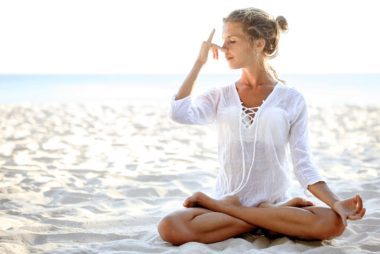
Breathing is so innate that most of us don’t even pay attention to how we do it, but there is a way to
breathe for better healthand for managing stress. "Breathing from your diaphragm oxygenates your blood, which helps you relax almost instantly," says Robert Cooper, Ph.D., coauthor of
The Power of 5, a book of five-second and five-minute health tips. Shallow chest breathing, by contrast, can cause your heart to beat faster and your muscles to tense up, exacerbating feelings of stress. To breathe deeply, begin by putting your hand on your abdomen just below the navel. Inhale slowly through your nose and watch your hand move out as your belly expands. Hold the breath for a few seconds, then exhale slowly. Repeat several times. Here's
how breathing can improve mindfulness.
Visualize calm
 PEOPLEIMAGES
It sounds New Age-y, but at least one study, done at the Cleveland Clinic Foundation, has found that it's highly effective in reducing stress. Dr. Cooper recommends imagining you're in a hot shower and a wave of relaxation is washing your stress down the drain. Gerald Epstein, MD, author of
Healing Visualizations, suggests the following routine: Close your eyes; take three long, slow breaths; and spend a few seconds picturing a relaxing scene, such as walking in a meadow, kneeling by a brook, or lying on the beach. Focus on the details—the sights, the sounds, the smells. (
This quick trick shuts down stress in the moment.)
Make time for a mini self-massage
 PEOPLEIMAGES
Maria Hernandez-Reif, Ph.D., of the Touch Research Institute at the University of Miami School of Medicine, recommends simply massaging the palm of one hand by making a circular motion with the thumb of the other. Or use a massage gadget. The
SelfCare catalog offers several, such as the S-shaped Tamm unit, that allows you to massage hard-to-reach spots on your back. Work in these
self-massage tricks for soothing full-body relaxation and help with managing stress.
Say cheese
 JACOBLUND
Smiling is a two-way mechanism. We do it when we're relaxed and happy, but doing it can also make us feel relaxed and happy. "Smiling transmits nerve impulses from the facial muscles to the limbic system, a key emotional center in the brain, tilting the neurochemical balance toward calm," Dr. Cooper explains. Go ahead and grin. Don't you feel like you're managing stress better already?
Here are 7 other scientific reasons you should smile more.
Do some math
 TOMML
TOMML
Using a scale of one to 10, with one being the equivalent of a minor hassle and 10 being a true catastrophe, assign a number to whatever it is that's making you feel anxious. "You'll find that most problems we encounter rate somewhere in the two to five range—in other words, they're really not such a big deal," says Dr. Elkin. (Speaking of math, can you pass
this elementary school math test?)
Stop gritting your teeth
 DENISKOMAROV
Stress tends to settle in certain parts of our bodies, the jaw being one of them. (Did you know dental problems can be
signs of disease in other parts of the body?) When things get hectic, try this tip from Dr. Cooper: Place your index fingertips on your jaw joints, just in front of your ears; clench your teeth and inhale deeply. Hold the breath for a moment, and as you exhale say, "Ah-h-h-h," then unclench your teeth. Repeat a few times and you'll be managing stress better in no time.
Compose a mantra
 KAJDI-SZABOLCS
Devise an affirmation—a short, clear, positive statement that focuses on your coping abilities. "Affirmations are a good way to silence the self-critical voice we all carry with us that only adds to our stress," Dr. Elkin says. The next time you feel as if your life is one disaster after another, repeat 10 times, "I feel calm. I can handle this." If you can’t come up with your own,
try one of these daily mantras.
Check your chi
 PEOPLEIMAGES
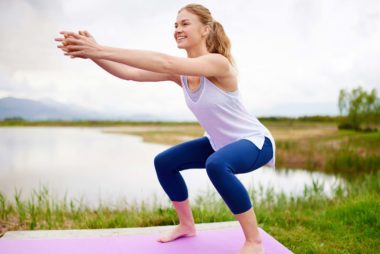
Qigong (pronounced chee-gong) is a 5,000-year-old Chinese practice designed to promote the flow of chi, the vital life force that flows throughout the body, regulating its functions. Qigong master Ching-Tse Lee, PhD, a professor of psychology at Brooklyn College in New York, recommends this calming exercise for managing stress: Stand with your feet shoulder-width apart and parallel. Bend your knees to a quarter-squat position (about 45 degrees) while keeping your upper body straight. Observe your breathing for a couple of breaths. Inhale and bring your arms slowly up in front of you to shoulder height with your elbows slightly bent. Exhale, stretching your arms straight out. Inhale again, bend your elbows slightly and drop your arms down slowly until your thumbs touch the sides of your legs. Exhale one more time, then stand up straight. If you think this sounds similar to yoga, you’d be right. Try some
easy yoga poses to reap the benefits without going to a class.
Be a fighter
 KUPICOO
"At the first sign of stress, you often hear people complain, 'What did I do to deserve this?'" says Dr. Cooper. The trouble is, feeling like a victim only increases feelings of stress and helplessness. (
These are signs you’re more stressed than you realize.) Instead, focus on being proactive. If your flight gets canceled, don't wallow in self-pity. Find another one. If your office is too hot or too cold, don't suffer in silence. Call the building manager and ask what can be done to make things more comfortable.
Put it on paper
 WUNDERVISUALS
Writing provides perspective, says Paul J. Rosch, MD, president of the American Institute of Stress. Divide a piece of paper into two parts. On the left side, list the stressors you may be able to change, and on the right, list the ones you can't. "Change what you can," Dr. Rosch suggests, "and stop fretting over what you can't." Another plus?
Writing also makes you smarter.
Count to 10
 GPOINTSTUDIO
Before you do something you’ll regret or
say something that makes the situation worse, step away from the stressor and collect yourself, advises Dr. Cooper. You can also look away for a moment or put the caller on hold. Use your time-out to take a few deep breaths, stretch, or recite an affirmation to make managing stress easier.
Switch to decaf
 MILOSSTANKOVIC
Wean yourself off slowly, or you might get a caffeine-withdrawal headache that could last for several days, cautions James Duke, Ph.D., author of
The Green Pharmacy. Subtract a little regular coffee and add some decaf to your morning cup. Over the next couple of weeks, gradually increase the proportion of decaf to regular until you're drinking all decaf. (
This is how you should be making your coffee.) You should also consider switching from regular soft drinks to caffeine-free ones or sparkling mineral water.
Just say no
 PEKIC
PEKIC
Trying to do everything is a one-way ticket to serious stress. Be clear about your limits, and stop trying to please everyone all the time. The first step to stop doing everything at once? Managing stress and your time well. Take this
time management advice from successful people to keep your stress in check.
Take a whiff
 ID-ART
Oils of anise, basil, bay, chamomile, eucalyptus,
lavender, peppermint, rose, and thyme are all soothing, say Kathy Keville and Mindy Green, coauthors of
Aromatherapy: A Complete Guide to the Healing Art. Place a few pieces of rock salt in a small vial, then add a couple of drops of the oil of your choice (the rock salt absorbs the oil and is much less risky to carry around in your purse than a bottle of oil). Open the vial and breathe in the scent whenever you need a quick stress release. Look for the oils in your local health food store, or try a mail-order company like Aroma-Vera or Leydet Aromatics.
Here are more remedies for natural managing stress and anxiety relief.
Say yes to pressure
 WEBPHOTOGRAPHEER
Acupressure stimulates the same points as
acupuncture, but with fingers instead of needles. Michael Reed Gach, Ph.D., director of the Acupressure Institute in Berkeley, California, recommends pressing on the following three points:
- The Third Eye, located between the eyebrows, in the indentation where the bridge of the nose meets the forehead.
- The Heavenly Pillar, on the back of the neck slightly below the base of the skull, about half an inch to the left or right of the spine.
- The Heavenly Rejuvenation, half an inch below the top of each shoulder, midway between the base of the neck and the outside of the shoulder blade.
Breathe deeply and apply firm, steady pressure on each point for two to three minutes. The pressure should cause a mild aching sensation, but not pain. Here are some
more pressure points to try.
Schedule worry time
 JOHNNYGREIG
Some stressors demand immediate attention—a smoke alarm siren or a police car's whirling red light. But many low-grade stressors can be dealt with at a later time, when it's more convenient. "File them away in a little mental compartment, or make a note," Dr. Elkin says, "then deal with them when the time is right. Don't let them control you." (By the way, here's
what successful people do during their commute.)
Shake it up
 KIEFERPIX
Stand or sit, stretch your arms out from your sides and shake your hands vigorously for about 10 seconds. This exercise loosens the muscles in your neck and upper back; if they're strained, they can cause a lot of pain. (Here are some
other ways to relieve muscle pain.) Combine it with a little deep breathing, Dr. Sobel says, and you'll do yourself twice as much good while still managing stress.
Munch some snacks
 BHOFACK2
Foods that are high in carbohydrates stimulate the release of serotonin, feel-good brain chemicals that help induce calm, says Dr. Cooper. Crackers, pretzels, or a bagel should do the trick. Be careful not to eat
too many carbs, though. They can just increase your appetite instead of managing stress.
Boost your vitamin intake
 JAKER5000
Elizabeth Somer, RD, author of
Food and Mood, recommends that women take a daily multivitamin and mineral formula that contains between 100 percent and 300 percent of the recommended dietary allowances of vitamin B, as well as calcium, magnesium, chromium, copper, iron, manganese, molybdenum, selenium and zinc. Stay away from stress formulas, which often contain large amounts of randomly formulated nutrients, such as the B vitamins, but little or nothing else, Somer says. If you already take vitamins, you could be making some
drastic vitamin mistakes without knowing it.
Get horizontal
 PEOPLEIMAGES
If sex has been on the bottom of your to-do list for too long, move it to the top. Sex increases levels of endorphins, those mood-boosting chemicals in the brain, and it's one of the best total-body relaxers around, says Louanne Cole Weston, PhD, a sex therapist in Sacramento, California. Make a date with your mate, and don't let anything get in the way.
Here are other surprising health benefits of having sex.
Admit it
 LAFLOR
Each of us has uniquely individual stress signals: neck or shoulder pain, shallow breathing, stammering, teeth gritting, queasiness, loss of temper. (If you tend to lose your temper, here are
some ways to control it.) Learn to identify yours, then say out loud, "I'm feeling stressed," when they crop up, recommends Dr. Rosch. Recognizing your personal stress signals helps in managing stress and slows the buildup of negativity and anxiety.
Space out
 GAWRAV
Look out the window and find something natural that captures your imagination, advises Dr. Sobel. Notice the clouds rolling by or the wind in the trees. Who knew spacing out could be so beneficial to managing stress? Plus,
daydreaming means you're smart!
Try tea
 PEOPLEIMAGES
By now most of us know about the calming properties (
and health benefits) of chamomile tea. But a steaming cup of catnip, passionflower, skullcap or kava kava also work, according to Dr. Duke. Whether you use tea bags or loose tea (one teaspoon of tea per cup of boiling water), steep for about 10 minutes to get the full benefits of the herbs. (You might even want to try
cooking with tea.)
Take a walk
 DAVIDF
Walking forces you to breathe more deeply and improves circulation, says Dr. Cooper, among other
health benefits of walking for 15 minutes. Step outside if you can; if that's not possible, you can gain many of the same benefits simply by walking to the bathroom or water cooler, or by pacing back and forth. "The key is to get up and move," Dr. Cooper says. (
Exercise makes your brain better, too.)
Soak it up
 JAZZIRT
"When I have the time, nothing is more stress relieving for me than a hot bath," Dr. Weston says. "But when I don't have time, I do the next-best thing: I wash my face or even just my hands and arms with hot water. The key is to imagine that I'm taking a hot bath. It's basically a visualization exercise, but the hot water makes it feel real." Check out these tips to make
managing stress even easier by making your bath as relaxing as possible.
Play a few bars
 OINEGUE
Listening to classical music is more than just a pleasant experience;
it’s a healthy one. A number of recent studies have shown that music can do everything from slow heart rate to increase endorphins. Good bets: Bach's Air on the G-String, Beethoven's
Pastorale symphony, Chopin's Nocturne in G, Handel's
Water Music, or pianist George Winston's CDs
Autumn or
December. Here are some more incredible
health benefits of listening to music.
Fall for puppy love
 GOLFYINTERLUDE
In a study of 100 women conducted last year at the State University of New York at Buffalo, researchers found that those who owned a dog had lower blood pressure than those who didn't. If you don't have a pooch, visit a friend's. According to researchers, petting an animal for just a couple of minutes helps in managing stress along with having
plenty of other health benefits.
Practice mindfulness
 ROBBIE
Mindfulness is all about living attentively in the moment, and it leads to relaxation. Heighten your awareness of the moment by focusing intently on an object. Notice a pencil's shape, color, weight, and feel. Slowly savor a piece of fruit or chocolate. To start your day mindfully, practice these simple
morning mindfulness exercises.
Call a friend
 KUPICOO
Sharing your troubles can give you perspective, help in managing stress, help you feel cared for, and relieve your burden. If your friend is comforting and offers advice, that’s a sign you have a true friend. (Here are some
things you can do to be a great friend.)
Stretch
 JACOBLUND
Muscles tighten during the course of the day, and when we feel stressed out, the process accelerates. Stretching loosens muscles and encourages deep breathing. Molly Fox, creative fitness director at the Equinox Fitness Center in New York City, says one of the greatest stress-relieving stretches is a yoga position called the child pose, which stretches the back muscles. On a rug or mat, kneel, sit back on your heels, then lean forward and put your forehead on the floor and your arms alongside your legs, palms up. Hold for one to three minutes. If you have a little more time to stretch,
try our 10-minute yoga workout.
Say a little prayer
 FRANCESCOCH
Organized religion may be losing members, but
prayer is more popular than ever. Studies show that compared with those who profess no faith, religious and spiritual people are calmer and healthier.
Make plans
 MIKOLETTE
"Looking forward to something provides calming perspective," Dr. Elkin says. Buying concert tickets, scheduling a weekend getaway, or making an appointment for a massage are all great ways of managing stress. (Here are some
things successful people do on the weekend.)
Goof off
 PIXELFIT
Goofing off is another great way of managing stress. It temporarily removes you from a potentially stressful situation. Esther Orioli, president of Essi Systems, a San Francisco consultant company that organizes stress-management programs, keeps a harmonica in the drawer for when she's feeling stressed out. Bonus: Playing it promotes deep breathing. (Speaking of goofing off, here are some
weird facts about laughter you never knew.)
Straighten up
 PEOPLEIMAGES
When people are under stress, they slump over as if they have the weight of the world on their shoulders. "Slumping restricts breathing and reduces blood and oxygen flow to the brain, adding to muscle tension and magnifying feelings of panic and helplessness," Dr. Cooper explains. Straightening your spine has just the opposite effect. It promotes circulation, increases oxygen levels in your blood and helps lessen muscle tension, all of which promote relaxation. The good news is, it only takes minutes to
improve your posture.
Tiptoe through the tulips
 ALEKSANDARNAKIC
Tending your garden helps get you out of your head and lets you commune with nature, a known way of managing stress. If you're not a gardener, tend to a houseplant (or check out these
beginner gardening tipsto help you change that). Plants = growth = cycle of life, a nice reminder that stress, too, will pass.
 LONDONEYE
 ISTOCK/KUZMA
মন্তব্যসমূহ
একটি মন্তব্য পোস্ট করুন